Concept Video
Feel the Story
Problem
Modern entertainment leans heavily on sound to portray pacing, story telling, and emotion.
While captions and subtitles provide access to dialogue for deaf users, they fail to convey the emotional and sensory depth created through music, sound effects, and audio design. As a result, many entertainment experiences become informational rather than immersive.
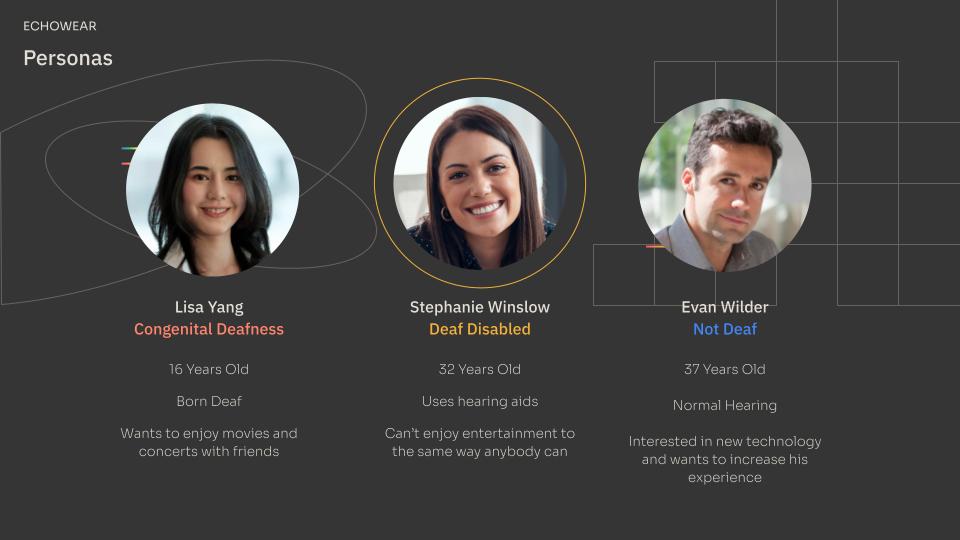
User Personas
Competitive Analysis
| X/10 | 4D Theaters | Haptic Vests | Captions/ Subtitles | ECHOWEAR |
| Deaf Accessibility | 3 | 4 | 6 | 10 |
| Wearable | 1 | 7 | 1 | 10 |
| Emotional Storytelling | 7 | 6 | 4 | 8 |
| Price | 8 | 2 | 10 | 5 |
Methods of Design
Personas
Personas were used to better understand the emotional, social, and entertainment related needs of deaf users. Since entertainment accessibility varies widely depending on lifestyle and media habits, personas helped identify different expectations around immersion, communication, and sensory engagement.
Persona Goals: To feel more immersed in movies and games. To experience emotional impact of entertainment. To enjoy entertainment socially with friends.
User Journey Maps
User journey mapping was used to understand how deaf users currently experience entertainment and where emotional disconnect occurs throughout the viewing process.
This helped identify moments where interaction could improve immersion. Common areas identified were lack of music accessibility, missing suspense and intensity emotion brings, and subtitles taking all the engagement which leads the users to an incomplete and lackluster experience.
Scenarios
Scenarios were used to explore how ECHOWEAR would function in realistic environments and emotional contexts.
This method helped define interaction behaviors, sensory pacing, and usability requirements.
Scenarios also allowed for the inclusion of many different entertainment options from gaming to concerts. Relating to the audience sympathetically allows for inclusion of people with many different disabilities.
Research through Design
Research through design was used to experiment with how touch could communicate emotion, intensity, and atmosphere through wearable interaction.
Instead of beginning with a fully defined solution, iterative prototyping changed as different scenarios and user needs evolved to create a more immersive experience. Discovery through design allows for the design to overcome challenges like overwhelming senses and inability to interpret haptic responses.
Solution
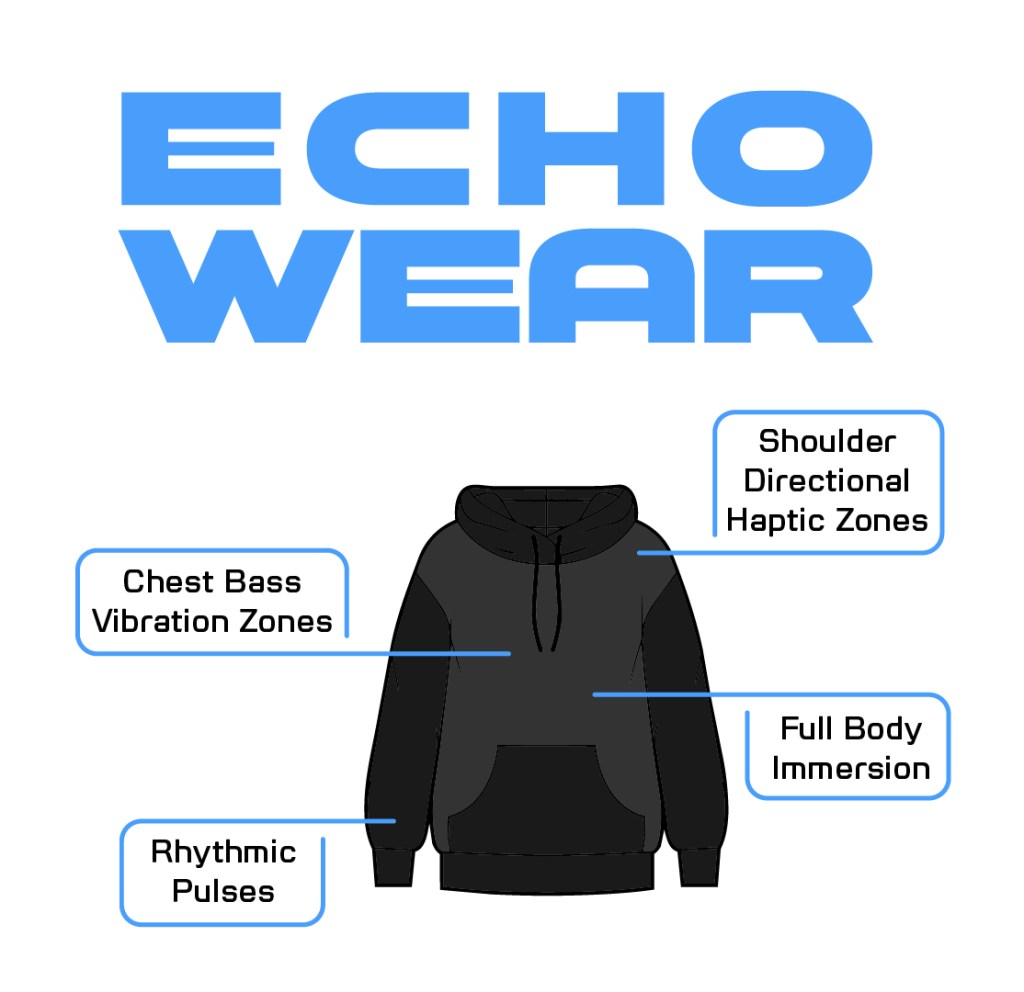
| Audio Type | Haptic Response |
| Dialogue | Soft Directional Pulses |
| Explosion | Full Torso Impact |
| Suspense | Increasing Rhythmic Pulses |
| Direction | Shoulder Haptic Reception |
| Bass | Deep Chest Vibration |
 derekbridge66-jxepb